
Where Releases from the Facility Go
The Mesa County Sheriff's Office describes the Mesa County Detention Facility as the county's main local custody point. The facility is at 215 Rice Street in Grand Junction and accepts arrestees for all local, state, and federal law-enforcement agencies in Mesa County. That means a person booked into this jail may have been brought by the sheriff, Grand Junction Police, another local agency, a state agency, or a federal authority.
For release research, that mixed intake role matters. A local detainee may leave the facility because bond was posted, a court ordered personal recognizance release, charges were dismissed, time was served, a warrant was cleared, or the person was sentenced to a local jail term. Another person may leave the public county locator because CDOC, another county, the U.S. Marshals Service, or an immigration-related channel has custody. Disappearance from the Mesa County locator is a lead, not a final answer.
How to Confirm a Release
The correct first stop is the official Mesa County Sheriff's Office Inmate Locator. It is a current-custody search that supports last name, date of birth, or booking number. If the person appears there, the record indicates current Mesa County custody rather than release. If the person does not appear, use the supporting official systems to find the release or transfer explanation.
- Search the Mesa County inmate locator by the strongest identifier available, ideally booking number or date of birth plus name.
- Check the Mesa County Blotter Reports for the daily Booking Summary Report around the booking date. The report documents recent booking context, not release.
- Use Colorado VINE or VINELink Colorado for custody status and release notifications when the person is in a participating custody feed.
- Search the Colorado Judicial Branch docket search, CoCourts, or request court records from the Judicial Branch record/document request form to find bond, disposition, sentence, mittimus, probation, dismissal, or warrant activity.
- If a Mesa County jail release record is needed, use the Mesa County open records request portal and ask narrowly for records of official action showing release date, release reason, and transfer destination if any.
If the court record shows a sentence or transfer to the Colorado Department of Corrections, use CDOC offender search rather than the county jail locator. CDOC is the state-prison, parole, release, and discharge path. If the case is federal, the federal court, U.S. Marshals Service, or BOP inmate locator may be the follow-up, depending on whether the person is pretrial, transported, sentenced, or already in BOP custody.
Facility Records and Contact
The sheriff's official detention page and contact page provide the public contact details for the Rice Street campus. Use the facility phone for jail information and the county open-records portal for written records requests. Court cases are not kept by Mesa County through the county CORA portal; those requests belong with the Colorado Judicial Branch or the Mesa County Justice Center.
Mesa County Detention Facility
215 Rice Street
Grand Junction, CO 81501
(970) 244-3500
Operated by the Mesa County Sheriff's Office
Sheriff Contact Details
Non-emergency dispatch: (970) 242-6707
Fax: (970) 244-3511
Office hours: 8:00 a.m.-4:00 p.m., Monday-Friday excluding holidays
Records Request Route
Mesa County open records request portal
Three working days, or up to ten days if extenuating circumstances apply
$0.25/page plus $30/hour after the first hour for county requests
About the Adult County Jail
Official source lead-in: the matched screenshot below comes from the Mesa County Sheriff's Office detention facility page listed in the image manifest.
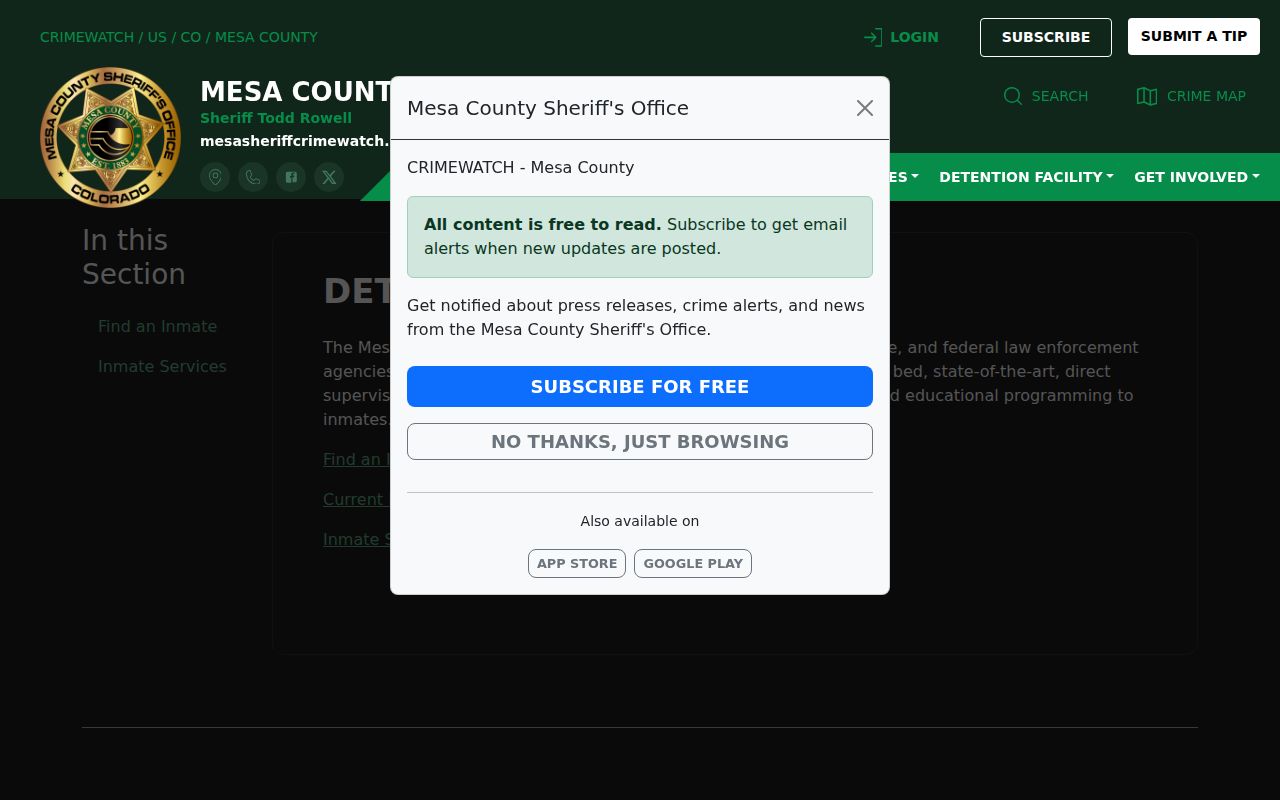
The detention page identifies the facility as a 553-bed direct-supervision facility. The same official description says it provides food service, 24-hour medical care, and educational programming. A separate accreditation post repeats the 553-bed direct-supervision description and the role accepting local, state, and federal arrestees.
Those details do not turn the county jail into a state prison or federal detention page. They explain why a person can be booked locally even when the follow-up release search later belongs to another system. The Mesa County jail record can document the local custody event, while the court, CDOC, BOP, USMS, or immigration-related path may explain the next custody status.
Transfers Are Not Always Community Release
Section 19 of the research highlights a key Mesa County issue: the facility accepts arrestees for local, state, and federal agencies. A person can leave the Mesa County Detention Facility because another agency took custody. That can look like release if the only check is the county locator, but the actual status may be transfer to CDOC, another county, federal pretrial custody, a BOP path after sentencing, or an immigration process.
For CDOC transfers, search by DOC number if known, or by name and gender if not. CDOC results may show a mugshot, physical descriptors, status, convictions, and parole, release, or discharge dates as applicable. A CDOC release to parole means the person has left prison custody but may still be supervised. A discharge is different because it can mean the sentence or supervision term has ended for that status.
For federal matters, use federal channels carefully. The BOP locator covers federal sentenced inmates from 1982 to present and may show a past release date with no current facility when the person is no longer in BOP custody. The U.S. Marshals Service is responsible for federal prisoners from court-ordered custody through transportation or delivery to BOP. For immigration questions, the research did not confirm that the Mesa County Detention Facility is an ICE detention center, so immigration should be framed as a possible transfer exception rather than a default Mesa County release result.
Booking Summaries and Photos
The Mesa County Blotter Reports page states that Booking Summary Reports list all people booked into the Mesa County Detention Facility within the last 24 hours of the report date. It also states that all law-enforcement agencies in Mesa County book custodial arrests into the facility and directs users to the arresting agency for further arrest details. The reviewed report showed commitments and booking fields, not a release feed.
That distinction matters for release records. A Booking Summary Report can show that the person entered the facility, when they were booked, what agency brought them, and what charges were listed. It does not by itself prove that the person was released, the release reason, or the exact release time. Use it to build the request or court search, then confirm release through VINE, court, sheriff records, or the correct state or federal path.
Booking photos are also separate. The reviewed Booking Summary Report did not include photos. Images may appear through specific CRIMEWATCH posts, warrant entries, registry pages, CDOC offender search, or a records request. If the photo is the needed item, request the booking photograph associated with the named booking number/date and ask whether any denial or redaction is based on CCJRA discretion, sealed status, juvenile status, or another legal authority.
Sheriff Contact Page Context
Official source lead-in: this matched manifest image comes from the Mesa County Sheriff's Office contact page, which supplies the address, phone, dispatch, fax, and office-hour details used above.
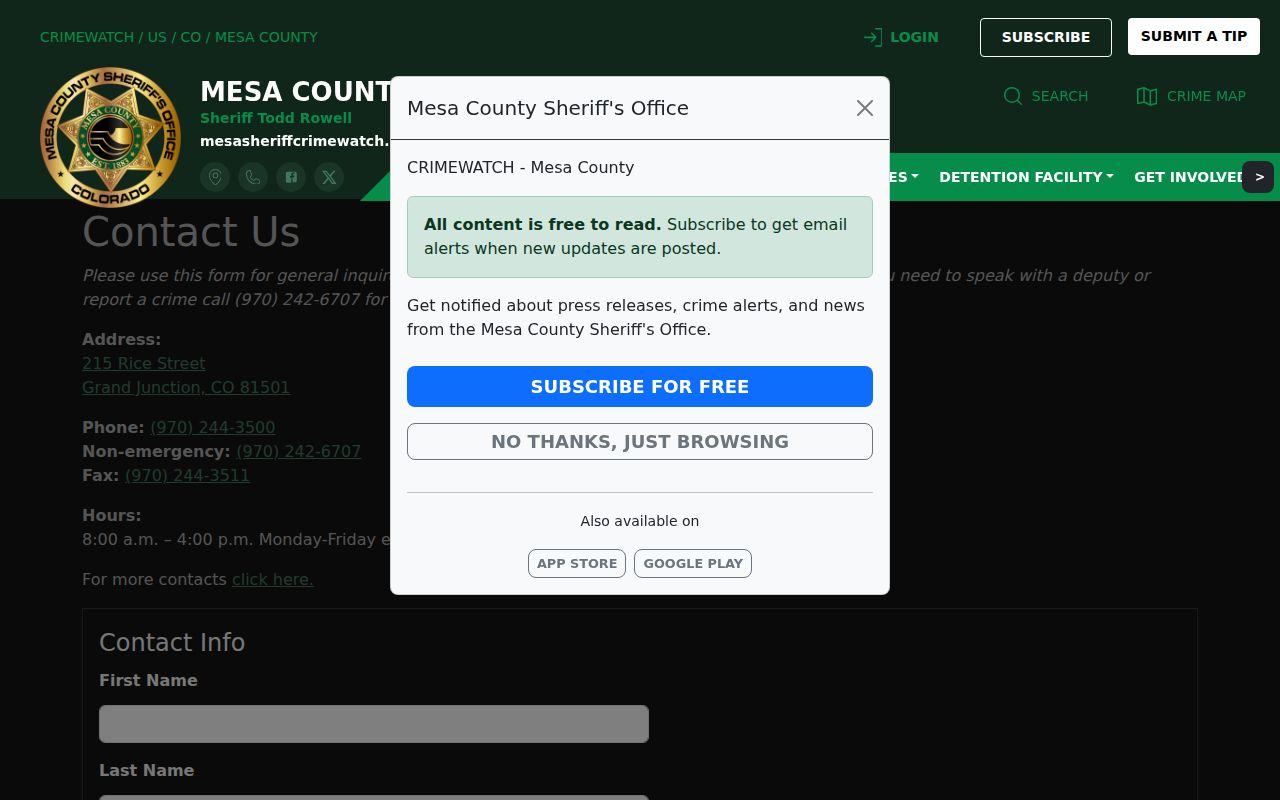
Use the contact page for general office details and the detention page for facility role and capacity. Use the open-records form for county records, and use the Colorado Judicial Branch for court case documents. Keeping those channels separate prevents a common mistake: asking the jail for a court disposition, or asking the court for the jail's exact physical release time.