
Projected vs Actual Release Date
A projected release date is a calculated or scheduled date. An actual release date is the date the custodian reports the person physically left custody or changed custody status. In Mesa County, that distinction matters because a person can leave the county jail by bond, court order, time served, sentence to probation, transfer to CDOC, transfer to another county, federal custody, or another hold. The live Mesa County Inmate Locator is a current-custody tool, not a complete release archive.
For state prison cases, CDOC date labels can have different meanings. A public record may show a parole eligibility date, mandatory release date, release date, parole date, discharge date, or another label from the official system. The page visitor should copy the exact label shown and avoid translating it into a promise. Parole eligibility is the first date a person may be considered for parole under the applicable law; it is not the same as guaranteed release.
How to Find a Mesa County Inmate's Projected Release Date
The first step is to decide whether the person is in local jail custody or state prison custody. The Mesa County Detention Facility handles local bookings and accepts arrestees for local, state, and federal law-enforcement agencies in Mesa County. CDOC handles state prison sentences and state parole or discharge dates. A county booking number is not a DOC number, and a missing county locator result does not prove a clean community release.
- Gather the full legal name, date of birth or age, booking number, court case number, and DOC number if available.
- Search the Mesa County Inmate Locator first if the person may still be in the county jail. It supports last name, date of birth, and booking number searches.
- If the person appears in the live locator, treat them as currently reported in Mesa County custody and confirm the next release authority through the court, jail records, or VINE.
- If the person does not appear, check the Mesa County Booking Summary PDFs for recent booking context. Those reports show booking fields but not release date or release reason in the reviewed sample.
- Search the Colorado Judicial Branch docket or CoCourts Register of Action for bond, sentence, probation, dismissal, warrant, mittimus, or other disposition information.
- For a CDOC sentence, search CDOC offender search by DOC number when possible. If the DOC number is unknown, search by last name, first name, and gender.
- Compare identifiers before relying on a date: age, physical descriptors, convictions, court case context, and status.
- Write down the exact CDOC status and date labels. If a date is critical, confirm with CDOC or the court rather than estimating from sentence length.
- Use Colorado VINE to register for release or custody-change alerts while the person remains in a covered custody feed.
The source image below is the manifest-matched CDOC offender search page. It is relevant for Mesa County only when the person has a state-prison or state-parole connection, such as a Mesa County case that resulted in a CDOC sentence.
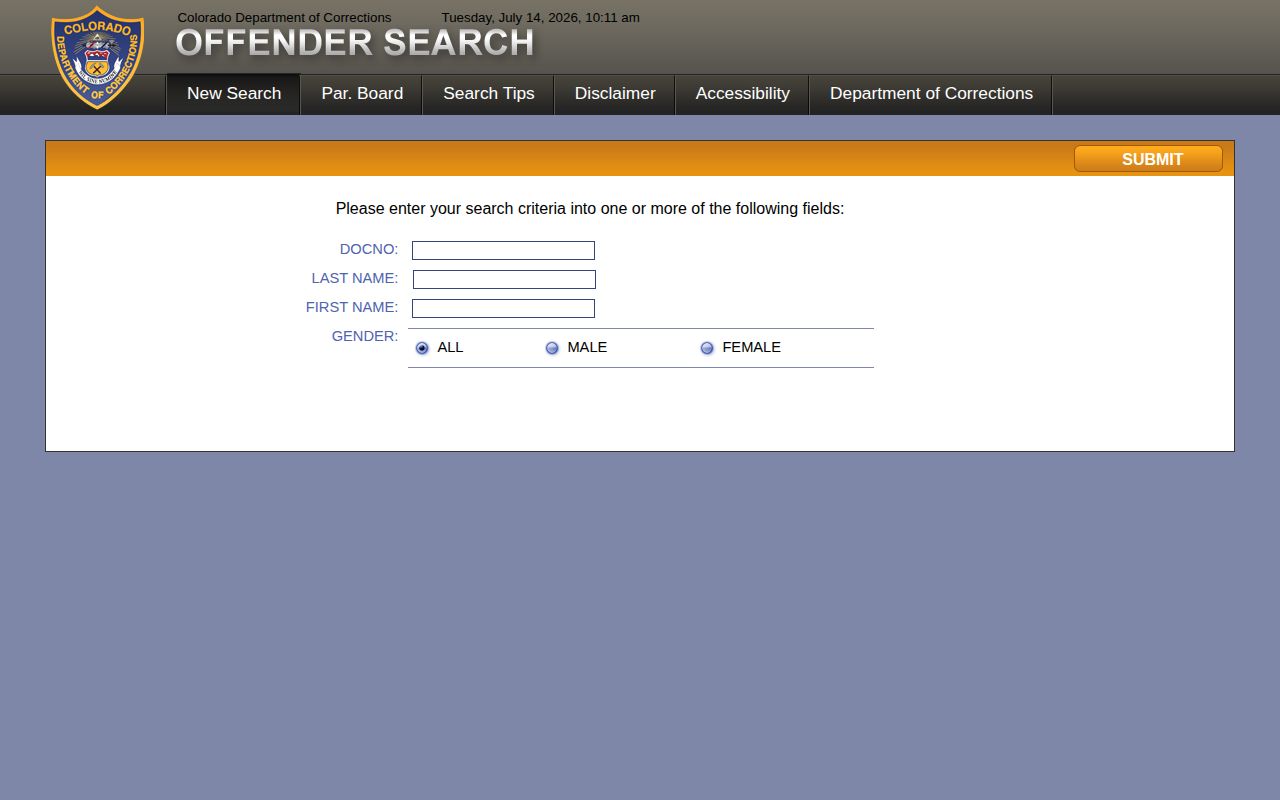
CDOC is not a substitute for a county jail release record. Use it for state custody, parole, release, or discharge dates, then return to the Mesa County court record to understand the sentence that sent the person to CDOC.
County Jail Dates Are Court Driven
The Mesa County sources reviewed do not publish a public automated projected jail-release date. For a person in the Mesa County Detention Facility, the release date can depend on a bond order, bond payment, personal recognizance release, sentence to time served, a jail sentence, a hold from another agency, a warrant, a court transport, or local processing after the release authority arrives. A person serving a short jail sentence may receive credit for time already served, but the public research did not identify a county-published good-time calculator for the jail.
For local jail cases, the court record is often the best explanation. The Mesa County Justice Center page gives the court location at 125 N. Spruce Street and links to local court services. Court records can show bond, sentence, probation, dismissal, warrant recall, mittimus to CDOC, or another disposition. Mesa County's CORA portal warns that court cases are not kept by Mesa County, so court documents should be requested through the Judicial Branch or the court rather than through the county's general open-records form.
Colorado Earned Time and Parole Eligibility
Colorado time computation is statute-specific and offense-specific. C.R.S. Section 17-22.5-405 provides earned time that may reduce a sentence based on demonstrated progress, including work or training progress and other statutory categories. The research identifies a general earned-time cap of up to ten days for each month of incarceration or parole, with certain lower-level felony and drug-felony provisions allowing up to twelve days per month when criteria are met. The statute also includes educational earned-time provisions.
Earned time should not be described as automatic release. Credits can depend on statutory eligibility, offense date, conduct, program progress, CDOC rules, and the sentence being served. Older offense-date frameworks can also matter. C.R.S. Section 17-22.5-301 includes good-time rules for certain earlier periods, including historical fifteen-days-per-month language for crimes committed during specified dates. C.R.S. Section 17-22.5-302 includes earned time in addition to good time for an older sentencing framework.
Parole eligibility is tied to C.R.S. Section 17-22.5-403 and related law. Many Colorado felony cases are publicly described as becoming parole eligible after a portion of the imposed sentence with credits, while violent, habitual, and specified serious categories can have higher thresholds such as 75 percent or specified 85 percent rules. The safe Mesa County explanation is that Colorado is not one universal percentage. A projected date can only be understood by reading the CDOC field, the court sentence, and the statutes that apply to the offense date and offense type.
Why a Projected Release Date Changes
Projected dates move because they are calculations, not guarantees. A Mesa County person may have one date in a county case, another date after a CDOC transfer, and another status after a parole-board decision. The table below separates common date-changing factors by the source most likely to explain them.
| Factor | How it can affect the date | Where to confirm |
|---|---|---|
| Earned time or good time | Credits may move a CDOC projected, parole eligibility, or discharge-related date when allowed by statute and CDOC rules. | CDOC record and applicable sentencing statute |
| Disciplinary issues | Credits may be withheld, lost, restored, or recalculated, changing the expected date. | CDOC records or formal records request |
| Presentence confinement credit | Time already served before sentencing can affect state time computation. | Sentencing order, mittimus, and CDOC date fields |
| Parole-board deferral or rescission | A parole eligibility date or grant does not always produce immediate physical release. | Parole-board hearing list, CDOC status, and court records |
| Detainers, warrants, or holds | A person may leave one custody status but remain held for another agency or case. | Mesa County jail, court docket, CDOC, USMS, BOP, or ICE channels as applicable |
| New case or court order | New charges, warrant recalls, bond changes, or sentencing orders can change the custody path. | Colorado Judicial Branch docket, CoCourts, or court document request |
Release, Parole, and Discharge Are Different
For a released-inmate search, the most common mistake is treating every date as final freedom from all legal control. A person can be released from the Mesa County Detention Facility and still have a pending court case. A person can be released from CDOC prison and remain on parole. A person can finish parole and then show a discharge date. Those are different statuses, and the record should be read with the label used by the issuing agency.
CDOC search may show release, parole, or discharge dates as applicable. Colorado Virtual Library's summary says CDOC results can include name, age, corrections number, mugshot, physical descriptors, parole, release, or discharge dates when applicable, and current convictions. If CDOC shows current facility custody, the person is not released from state custody even if they left the county jail. If CDOC shows parole or release but not discharge, supervision may still be active. If CDOC shows discharge, the CDOC sentence or supervision may be complete, subject to any other case or jurisdiction.
Confirming a Release Date
Use the most direct agency for the status being confirmed. For county jail release, use the Mesa County Inmate Locator for current custody, the Booking Summary Reports for recent booking context, the court docket for release authority, Colorado VINE for custody-change alerts, and a narrow sheriff records request for formal release records. For CDOC release, use CDOC offender search and CDOC records channels. For probation, use the court case and Mesa County Probation contact information. For federal sentenced prisoners, use BOP rather than the county jail or CDOC.
Colorado VINE is useful when the person is still in a covered custody feed and the goal is notification. It can send release or custody-change alerts by phone, email, text, TTY, or app where offered, and the Colorado VINE phone number is 1-888-263-8463. VINE is not a full court disposition, sentence calculation file, or certified jail record, so pair any alert with the originating agency when the date must be exact. The related VINELink check page explains the one-person registration process.