
Parole vs Probation in Mesa County
Parole and probation both involve supervision in the community, but they come from different orders and are verified in different places. Probation is usually part of the criminal court sentence. It can begin after a plea, after a jail term, after a deferred judgment, or after a split sentence. Mesa County probation cases belong to Colorado's 21st Judicial District, and the public starting point is the court case because the court orders, modifies, revokes, or terminates probation.
Parole follows a state prison sentence. A Mesa County case can leave the local jail when the person is sentenced to CDOC and transported to state custody. Later, CDOC records and parole-board materials may show parole eligibility, parole or release dates, hearings, revocations, and discharge from parole. A person on parole is no longer housed in a prison facility in the ordinary sense, but they may still be under CDOC supervision until parole is discharged.
| Status | Who supervises it | Best first record source |
|---|---|---|
| County jail release before final sentence | Mesa County Detention Facility and the court order controlling release | Mesa County Inmate Locator, court docket, VINE, and sheriff records request |
| Probation | 21st Judicial District Probation Department in Mesa County | Mesa County court case, Register of Action, probation order, or probation termination order |
| Parole | CDOC Adult Parole with decisions by the Colorado State Board of Parole | CDOC offender search and the Colorado parole hearing list |
| Discharge | The agency or court that controlled the sentence or supervision | CDOC release or discharge dates for prison cases; court records for probation completion |
Verify Mesa County Supervision Status
The most reliable verification path follows the legal source of the supervision. If the question is whether a released Mesa County person is on probation, start with the court case in the 21st Judicial District. A docket, Register of Action, sentencing order, probation order, revocation setting, or order terminating probation is the public record that explains the status. Probation offices may not disclose every detail to third parties, so the court record is usually the better public-facing source.
If the question is parole, start with CDOC offender search. CDOC records can show the DOC number, status, convictions, facility or parole status, and parole, release, or discharge dates when applicable. The Colorado State Board of Parole hearing list is within the CDOC offender-search environment and is the public path for scheduled parole hearings. Colorado Virtual Library describes the parole-board database as searchable by individual, month, or county and as a source for upcoming hearing dates.
- Identify the custody path: Mesa County jail only, Mesa County court probation, or a CDOC state-prison sentence.
- For a recent jail release, search the Mesa County Inmate Locator. If the person still appears, they are currently reported in local custody.
- For probation, search the Colorado Judicial Branch docket, CoCourts Register of Action, or request court documents from the Mesa County Justice Center.
- Look for the specific court event: sentence to probation, probation revocation, warrant, termination of probation, or a later order changing conditions.
- For parole, search CDOC by DOC number when available. If not, use name and gender, then compare age, physical descriptors, convictions, and date fields.
- Check the Colorado State Board of Parole hearing list for scheduled parole hearings when the person is still in or connected to CDOC custody.
- Use Colorado VINE for custody-change notification, especially when a person is still in custody and you need an alert for release, transfer, or status change.
- If a formal release or discharge record is needed, request the narrow record from the agency that holds it: sheriff records for jail release, court records for probation, or CDOC for prison/parole records.
Mesa County Probation Office
Mesa County Probation is a concrete local office, not a jail roster. The official probation page lists the office at 200 S. Spruce Street in Grand Junction and identifies William Riebel as Chief Probation Officer. The Judicial Branch location page notes that the probation department moved to the Central Services Campus next to the Elections Office, which matters because the main Mesa County court address is the Justice Center on N. Spruce Street and the jail is on Rice Street.
Mesa County Probation
200 S. Spruce Street
Grand Junction, CO 81501
970-257-3600
21st Judicial District Probation Department
Mesa County Justice Center
125 N. Spruce St.
P.O. Box 20,000-5030
Grand Junction, CO 81501
970-257-3640
The source image below is the matched Mesa County Probation page from the project manifest. It is included here because it documents the local probation office rather than a generic statewide supervision office.
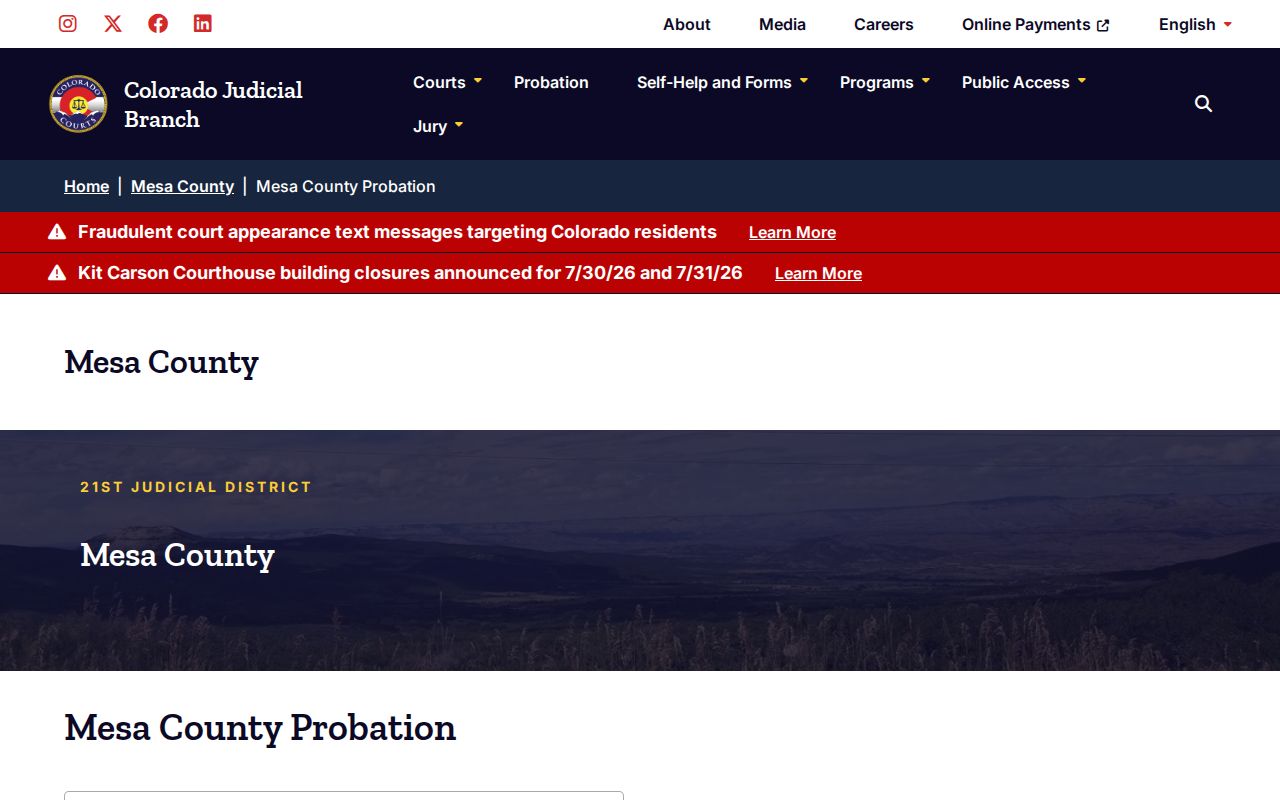
Use that probation page for office identification, but use the court case for public proof that probation was ordered, revoked, modified, or terminated.
Colorado Parole Hearings After a Mesa County Sentence
A person sentenced in Mesa County District Court to CDOC may later appear on a parole hearing list even if the hearing is connected to a state facility outside Mesa County. The local court case explains the conviction and sentence; CDOC and the parole-board tools explain the state-prison and post-prison release path. The Colorado State Board of Parole hearing-search URL is https://www.doc.state.co.us/oss/index.php?ref=pblist.
A hearing date or grant should not be treated as the same thing as walking out of custody. Parole-board outcomes can include release or designation for release, deferral, full-board review, file review, rescission, revocation-related decisions, and early discharge reviews. A planned release can still be affected by an approved release plan, a detainer, institutional conduct, a rescission decision, a new case, or another hold.
Colorado parole eligibility is tied to C.R.S. Section 17-22.5-403 and related sentencing provisions. Good-time and earned-time statutes, including C.R.S. Sections 17-22.5-301, 17-22.5-302, and 17-22.5-405, may affect timing depending on offense date and sentence. For Mesa County readers, the practical rule is simple: do not reduce Colorado parole to one percentage. Read the CDOC date field, compare it with the court sentence, and confirm important dates with the official agency.
Warrants, Violations, and Absconder Checks
Warrant status can overlap with release, but it is not a release list. Mesa County publishes a CRIMEWATCH warrants page with named wanted persons, images for some entries, charge summaries, and sheriff contact information. A person may have been released from jail on one case and later become wanted on a new warrant, a failure to appear, a probation violation, or a parole issue. That later status does not erase the original release; it adds a new custody or supervision problem to verify.
The source image below is the manifest-matched Mesa County Sheriff's Office warrants page. It fits this page because warrants are a follow-up status check for released people under supervision, not because the warrants page proves parole or probation by itself.
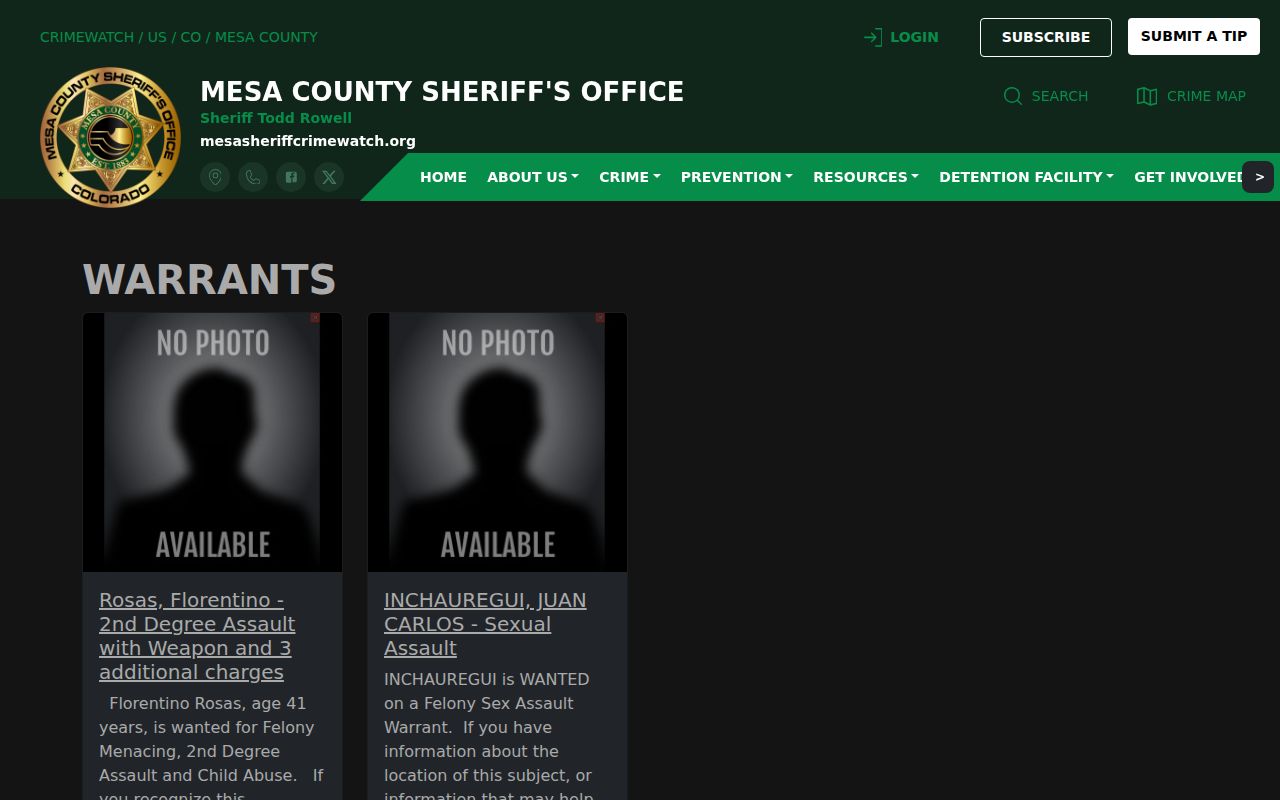
For probation violations, look at the court case first because the 21st Judicial District creates the public case events. For parole warrants or parole returns, use CDOC and parole-board channels. For immediate custody status, use the Mesa County Inmate Locator if local custody is suspected and Colorado VINE for custody-change alerts where the data feed is available.
How Mesa County Supervision Ends
Probation ends through the court record. The useful documents are the Register of Action, sentencing order, probation order, revocation order if any, and order terminating probation. A missing current jail record does not prove that probation ended. It may only mean the person is no longer housed at the Mesa County Detention Facility.
Parole or CDOC supervision ends through CDOC and parole records. CDOC search may show parole, release, or discharge dates as applicable. If the person is shown as released to parole but not discharged, they may be in the community while still supervised. If CDOC shows discharge, the state prison sentence or supervision obligation may be complete, subject to the exact record label and any other case or jurisdiction.
Formal release and discharge proof should come from the record holder. Mesa County's records request portal is for county records and says court cases are not kept by Mesa County. Court documents should be requested from the Colorado Judicial Branch or the Mesa County Justice Center. CDOC records should be handled through CDOC channels when the person has a state-prison or parole record. Colorado VINE can help with alerts, but VINE is not the complete court file or the complete jail record.